
Insights · Planning your application
Custom software development cost: scope before price.
Understand what changes the estimate, compare two scopes for the same workflow and know what to ask before committing to a build.
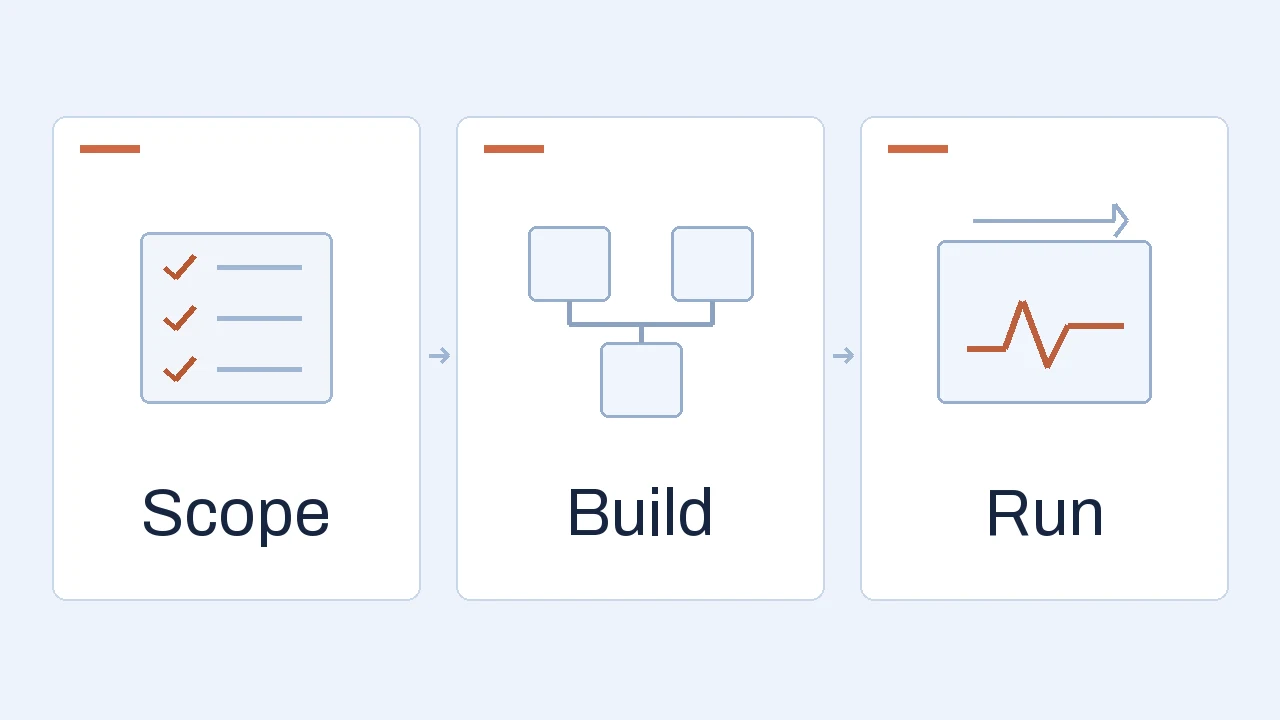
Custom software development cost depends on what the first version must do, the systems it connects to and the checks needed before people can rely on it. Compare the delivery boundary first, then separate the build price from running costs and later changes.
How much should you budget?
Clutch’s software development pricing guide, updated September 21, 2026, identifies $10,000–$49,999 as a typical band for projects reviewed on its platform. Its reported mean is about $132,480. These are different views of a mixed marketplace dataset, rather than a price for a comparable US business application.
Use those figures as context. To compare proposals, first describe the job your application must complete. The same request can produce very different scopes, as this order-review example shows.
One order workflow, two different scopes
A team reviews customer orders before entering them in an ERP. Both versions below help with that task, but the connected version takes responsibility for more of the journey.
Assisted review
Keep the existing import process.
- InputConsistent CSVAn operator uploads the order data.
- PrepareCheck the fieldsValidate required values and known reference codes.
- ReviewA person resolves flagsCorrect incomplete or invalid rows.
- OutputReviewed exportAn operator imports it into the ERP.
Recovery check Identify a repeat upload before processing it again.
Connected intake
Add document handling and an ERP connection.
- InputEmail and documentsReceive the agreed order formats.
- PrepareExtract and matchRead fields and match customer and product records.
- ReviewA person resolves uncertaintyConfirm unclear fields before the handoff.
- OutputERP draftCreate a draft through an agreed interface.
Additional recovery work Handle repeated messages and retry failed writes without creating another order.
What changes the estimate? Extraction, record matching, system access and recovery add work to the connected version. The assisted version can be enough when a controlled import already works.
Before choosing, check order volume, common exceptions and ERP access. To make acceptance concrete, submit the same source twice and agree how the system should identify the repeat. For the connected version, also test an interrupted ERP request and its retry. Our order entry automation guide works through the review decisions and different recovery paths.
What changes the estimate?
Rules and exceptions
Define the decisions behind each screen: required fields, approval rules, corrections and duplicate handling. Show a normal order and a common exception. That gives an estimator more to work with than a feature called “order management.”
Data and connections
Confirm record quality, matching identifiers, available interfaces and test access. Name the owner of each system and who resolves conflicting records. Our ERP integration service explains how we approach these connections and their failure paths.
Access and delivery checks
Agree user permissions, acceptance tests, deployment and handover responsibilities. The OWASP Application Security Verification Standard is one reference for defining verifiable security requirements. Translate the relevant requirements into checks for the actual application.
What should a useful estimate explain?
A software development cost breakdown should connect the price to work you can recognize. For the connected order workflow, ask whether extraction, reference matching, review screens, ERP writing and recovery testing are included.
- Delivery work: what will be designed, built, checked and introduced, with design and testing included clearly rather than counted twice.
- Unknowns: what depends on sample documents, data quality or system access, and how investigation or changed requirements affect the budget.
- Commercial basis: the agreed fixed scope or effort/rate assumptions, approval checkpoints and charges outside the build.
If ERP access is unconfirmed, ask the supplier to identify that dependency before treating a connected workflow as a fixed commitment. Resolving one uncertain connection can be a useful first stage.
What to budget after launch
The build price covers only part of ownership. Request an operating-cost view for the expected workload, plus responsibilities for support and future changes. The AWS cost optimization guidance treats usage awareness and ongoing optimization as part of running a workload.
- Before launch
Build the first version
- Workflow and interface design
- Application and agreed connections
- Testing, deployment and handover
Which deliverables does the build price include?
- While it is in use
Keep it running
- Hosting and external-service usage
- Monitoring, backups and recovery
- Support and security updates
Who pays, maintains and responds?
- As needs change
Extend the accepted version
- New business rules or reports
- Additional user roles
- New system connections
What counts as separately approved work?
Your team’s time spans all three. Budget for process decisions, sample data, acceptance and ongoing ownership alongside supplier charges.
Separate defect support from later improvements. Agree what support covers, which accounts you control and how you can export your data. There is no maintenance percentage established by this diagram; request costs based on your workload and support arrangement.
Fixed price or time and materials?
Choose the commercial model around how clearly the work can be described and how much is likely to change.
| Model | Useful when | Agree before starting |
|---|---|---|
| Fixed scope and price | Inputs and acceptance conditions are clear. | Deliverables, exclusions and treatment of scope changes. |
| Time and materials | Requirements evolve through working increments. | Rates, budget checkpoints, progress reporting and spending approval. |
| Staged delivery | An uncertain area needs investigation first. | What each stage delivers and the decision before the next commitment. |
How to reduce scope without weakening the workflow
Before committing to a build, compare custom software with off-the-shelf options. That guide tests the same workflow across existing tools, product configuration and a targeted custom component.
Start with one complete job. In the order example, reviewed data ready for the existing import process may be sufficient. Automatic ERP writing can follow when volume and access justify it. Reuse suitable identity, reporting and ready-made software capabilities.
Keep the controls that make that smaller version usable: permissions, duplicate checks and a recovery path. Remove optional convenience before shifting necessary checks back to an operator.
Distinguish AI used during development from AI inside the finished application. Document extraction introduces validation, human review and recurring usage costs. Ask which work AI changes rather than assuming a percentage saving.
What to send before asking for a quote
You can start with a process example instead of a finished technical specification. Share:
- The task people perform and the outcome you want.
- A redacted input and the output someone should accept.
- The users, permissions and person responsible for decisions.
- The systems involved and what you know about access.
- A normal case, a common exception and approximate volume.
- Budget boundaries, deadline dependencies and your team’s availability.
Our custom web application development service explains how we turn those inputs into agreed scope, working versions and delivery checks. See how we work with your team for the steps and responsibilities.
Frequently asked questions
How much does custom software development cost for a small business?
Start by pricing one useful version of the workflow. The number of users alone is not enough: data quality, connections, permissions and exceptions change the work. Marketplace figures provide context, while a scoped proposal establishes the budget for your project.
Why do software development quotes vary so much?
Suppliers may assume different inputs, integrations, checks and support responsibilities behind the same feature list. Compare deliverables, exclusions and acceptance conditions before comparing totals. Ask each supplier to explain the assumptions and unknowns that could change its estimate.
Should maintenance be included in the project price?
Ask for build and ongoing costs to be shown separately. Clarify defect support, hosting, subscriptions, security updates and future changes. Agree what the support arrangement covers and what remains your responsibility, rather than assuming every post-launch task is included.
Does AI make custom software cheaper?
AI used during development and AI included in the finished workflow affect different parts of the budget. An extraction feature still needs validation, review and handling of uncertain results. Ask which work changes and what ongoing costs are introduced.
Apply this to your workflow
What would your first useful version include?
Tell us what your team does today, which systems are involved and where work gets stuck. A redacted input example helps us discuss the scope and the questions to resolve before estimating.
Discuss your application How we deliver business applications