Supplier follow-up preparation
Find the relevant order and conversation, identify what is missing and prepare the next message for review.
 Let’s talk
Agents & assistants
Some tasks need more than a fixed set of rules. We build AI agents that gather the right context, use agreed tools and prepare the next action, with clear limits on what they can do.
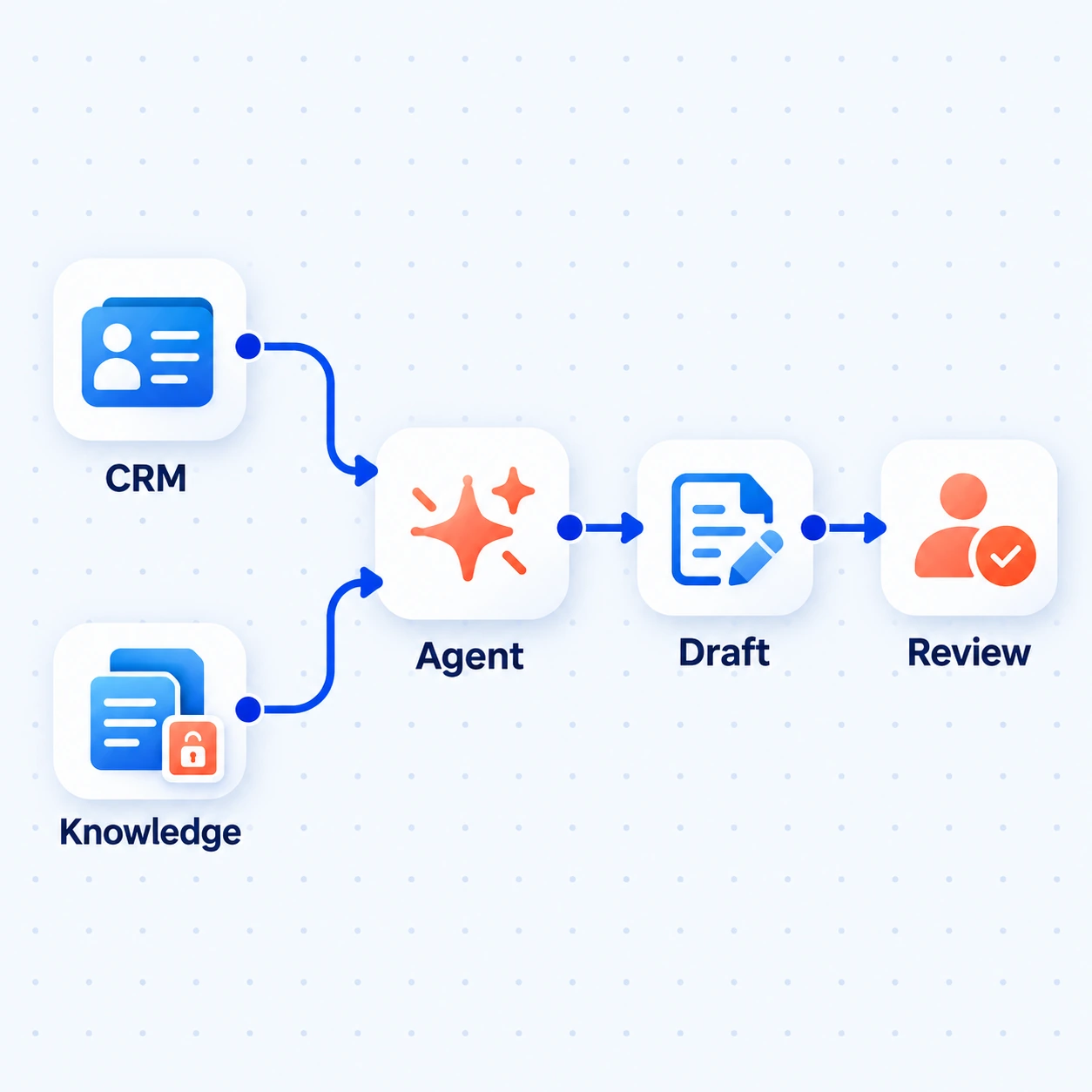
The agent uses agreed CRM context and knowledge to prepare a draft for a person to check.
Illustrative task · Tools and permissions agreed in scopeHow we deliver this service
We work through example requests, define the context and tools the agent needs, and agree what it can read, prepare or change. We evaluate its responses and stopping points before introducing it to the people responsible for the task.
We can build the interface, workflow and system connections around an assistant as well as the agent itself. That lets us plan the whole task, including how a reviewer sees the context, checks a draft and handles a request the agent cannot finish.
See our delivery processSee the work
Illustrative example · sample data, not client results.
A supplier emails a revised date for PO 482. The planner must find the order, check the customer commitment and decide who needs an update.
The agent retrieves the linked order and conversation, compares the dates and drafts a planner task. If the order reference is ambiguous, it asks for clarification.
The planner gets the supplier message, affected commitment and a suggested customer update together. The message remains a draft and the business records remain unchanged.
Step 1 of 3
This example gives the agent permission to read and draft. Sending or updating would need a separately defined approval path.
Where it helps
Find the relevant order and conversation, identify what is missing and prepare the next message for review.
Read an incoming request, retrieve the linked records and propose the right team or next task.
Find approved guidance and relevant account details, then prepare a source-linked response or hand the issue to a person.
What’s included
A task-focused assistant connected to agreed tools, with clear permissions, escalation and visible run history.
Set the starting request, successful response and stopping point. A supplier follow-up assistant needs a focused responsibility.
Connect the records, documents and actions needed for that job. Give reading, drafting and system changes separate permissions.
Handle ambiguity, missing information and unavailable tools with a question, approval request or useful escalation.
Evaluate real scenarios and failures. Set limits for steps, retries, time and cost, with run history for investigation.
What you receive
Agreed task scenarios, ambiguous inputs and tool failures are evaluated; the reviewer can see what the agent used and what still needs approval.
The first conversation
We’ll work through a real task and its decision points, then compare an agent with a simpler workflow. The first question is what useful work it should finish.
The next decision: whether the task needs an agent, which access is required and what a small evaluation should cover.
Useful answers
A chatbot is an interface for conversation. An agent can also choose and use authorised tools to complete a task. It may combine conversation, search and a small set of actions.
When the route is predictable. An agent is more useful when it must interpret varied information or gather context before choosing the next step.
Only with the permissions and approval rules defined for that task. Reading, preparing a draft and executing an action are different responsibilities.
Start by testing one focused agent. Multiple agents add coordination and evaluation work; use them when separate responsibilities justify it.
Set step, time, retry and cost limits, with an escalation path. Test unavailable tools and instructions it should reject. Those checks reduce risk without guaranteeing perfect behaviour.
Let’s talk about your work
Start with the task that sends people searching through several tools.
What we’ll discuss ↑← All services