A demo needs a working process
Add the review queue, connections and failure handling needed to complete the task outside a controlled demonstration.
 Let’s talk
Rollout & adoption
A promising pilot is a good start. Getting people to use it every day takes more work. We help close the technical gaps, prepare the team and introduce AI into a workflow someone owns.
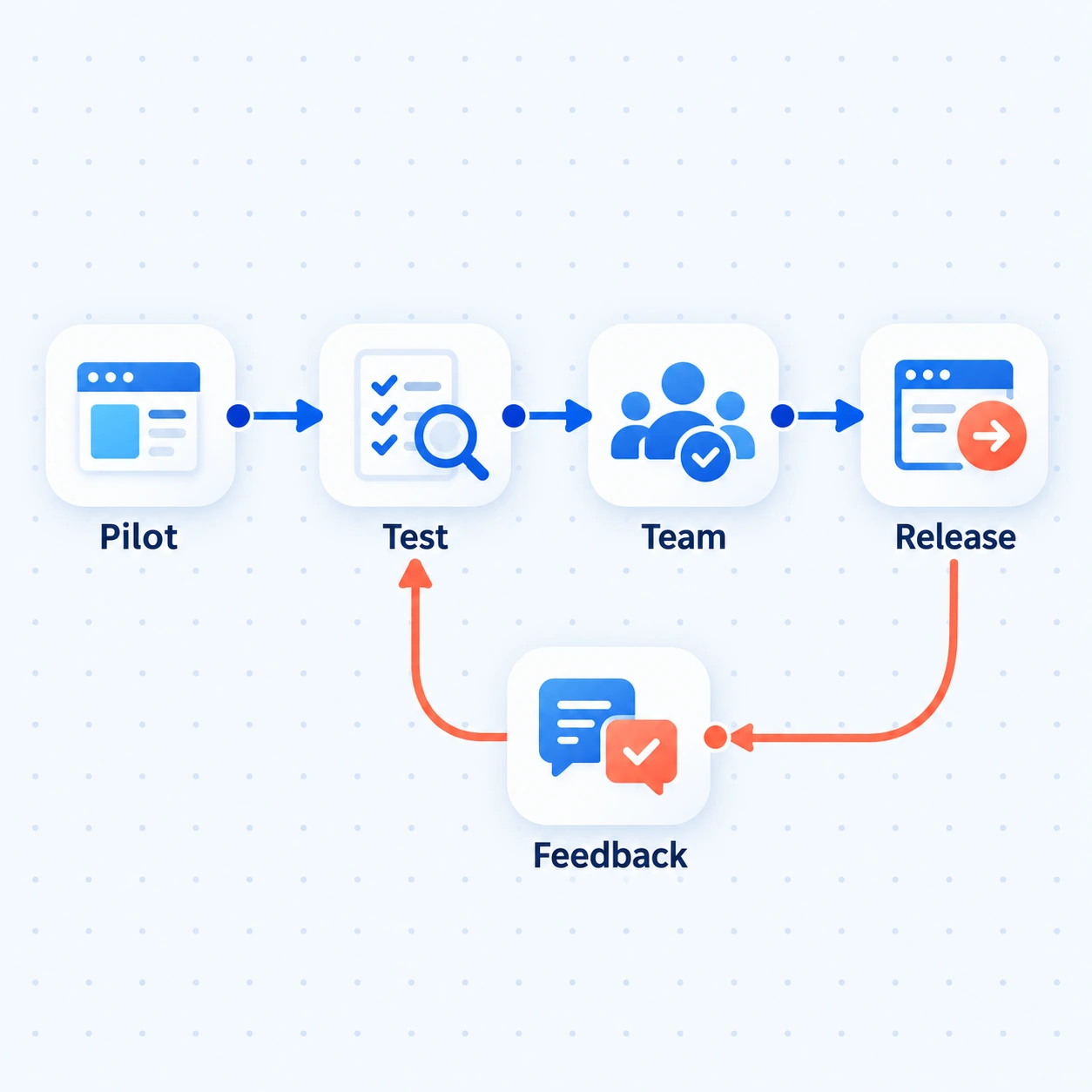
Test the workflow, prepare the people using it and use feedback from the release to guide the next improvement.
Illustrative rollout · Release follows agreed checksHow we deliver this service
We review the pilot with its users and technical owner, identify the gaps and agree a limited release. We complete the workflow, test realistic cases and prepare practical guidance, then review readiness with the people who will operate it.
We can work on the application, automation and system connections as well as the rollout. That keeps technical fixes, user feedback and operating responsibilities in one implementation plan.
See our delivery processSee the work
Illustrative example · sample data, not client results.
The pilot reads clean PDFs. During a team trial, a duplicate order and a scanned document reveal gaps in the review process.
We add those cases to the test set, define duplicate handling and give uncertain scans a review route. Users practise correcting a draft and reporting a failed run.
The release review has test findings, a named order-desk owner, working instructions and unresolved issues. Your team can decide whether to release, narrow the scope or test again.
Step 1 of 3
A rollout is a decision based on evidence. The scenario does not assume that the pilot passes or that adoption follows automatically.
Where it helps
Add the review queue, connections and failure handling needed to complete the task outside a controlled demonstration.
Test familiar examples, work through exceptions and give each user group practical guidance.
Agree who monitors quality, handles issues and makes the call on changes or wider rollout.
What’s included
An agreed rollout with acceptance evidence, operating guidance, named owners and a support plan.
Inspect the pilot, sample results and dependencies. Identify reusable work and the gaps preventing wider use.
Address access, integrations, reviews and failures. Test with the people who will operate the workflow.
Walk each user group through familiar tasks, corrections and exceptions. Use their feedback to improve the experience.
Define quality monitoring, maintenance and support ownership. Release to a limited group before considering wider use.
What you receive
Release criteria are reviewed, users have practical guidance, operational ownership is assigned and there is a route for reporting and resolving issues.
The first conversation
We’ll review what works, where users get stuck and which technical or operational gaps stand between the pilot and everyday use.
The next decision: what must be fixed or tested before a limited release, and who needs to be involved.
Useful answers
We can assess the code or configuration, documentation and sample results first, then explain what can be reused.
We can discuss a first pilot and its delivery path. If the use case or investment decision is unclear, strategy consulting may come first.
Task walkthroughs, working guidance, correction and escalation practice, and a feedback route. Completing a training session alone does not establish adoption.
We propose phases after reviewing the starting point and user groups. Monitoring, maintenance, availability and response expectations are defined in the support scope.
Let’s talk about your work
Bring what you have built and the questions it has not answered.
What we’ll discuss ↑← All services