Choose a first AI project
Compare the repeated tasks your teams want help with, using value, readiness and effort rather than enthusiasm for a tool.
 Let’s talk
Strategy & direction
You have ideas for AI. The harder question is which one is worth doing first. We work through your processes, data and systems with you, then turn the options into a practical plan.
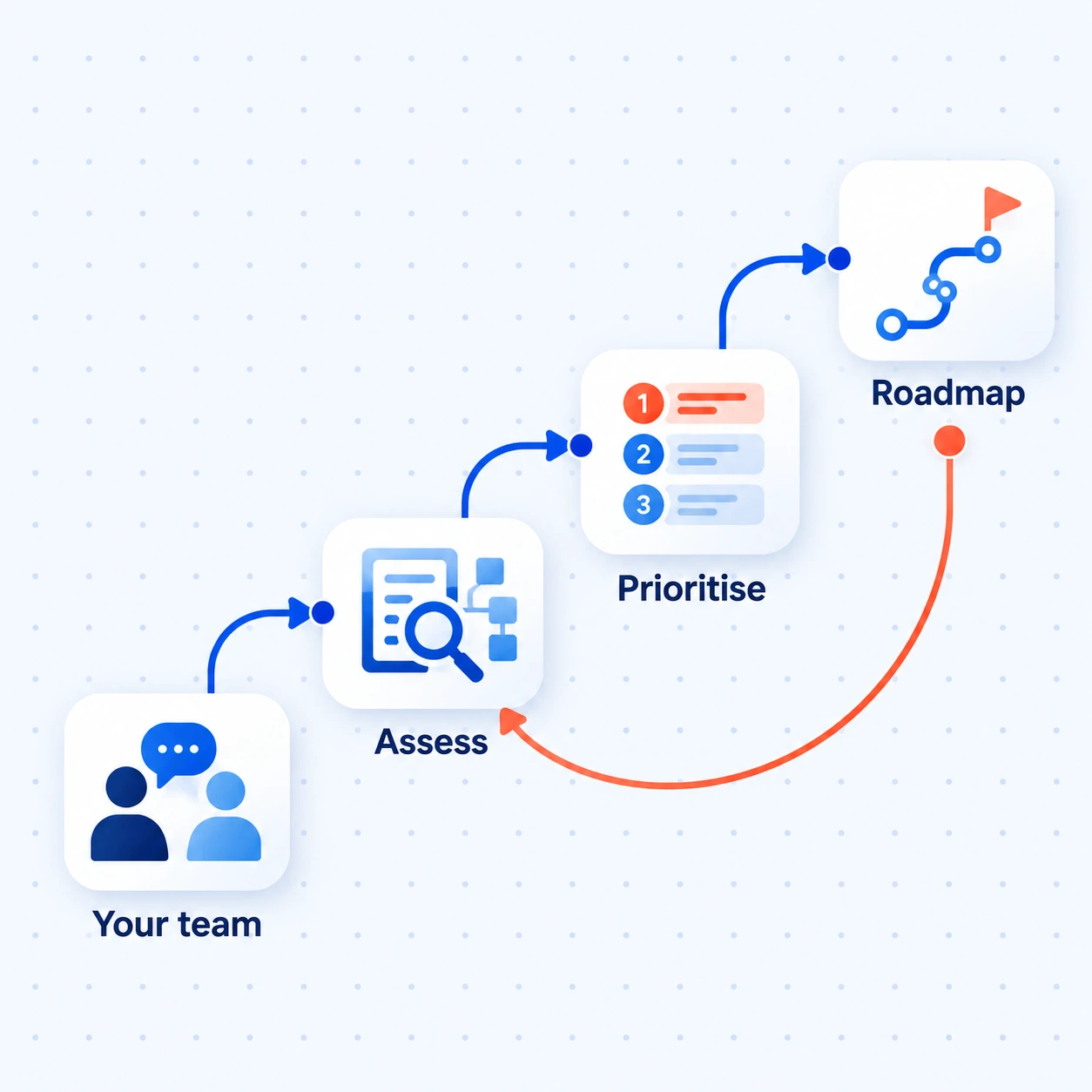
Work with your team to assess readiness, compare opportunities and shape a roadmap you can revisit as priorities change.
Illustrative assessment · Led by peopleHow we deliver this service
We review actual tasks with their owners, inspect the data and system access, and compare the possible approaches. Together we choose what to investigate or pilot first, with dependencies, ownership and success measures written into the plan.
We bring our founder’s operations, enterprise IT and automation experience into the assessment. That helps connect an attractive AI idea with practical constraints and a project your team can own. We consider existing software and ordinary automation alongside AI.
The experience behind our approachSee the work
Illustrative example · sample data, not client results.
Operations wants order extraction, sales wants a CRM assistant and support wants document search. The team has not compared the work behind those requests.
We walk through an order, a sales enquiry and a support question. For each, we check repetition, available data, system access and what a useful pilot would need to prove.
A decision sheet compares the three options, records missing evidence and defines the next assessment or pilot. A blocked integration might put a promising idea later in the sequence.
Step 1 of 3
No winner or return is assumed here. The recommendation follows your process evidence and investment priorities.
Where it helps
Compare the repeated tasks your teams want help with, using value, readiness and effort rather than enthusiasm for a tool.
Review what has been tried, what the evidence shows and what must change before further investment.
Agree priorities, owners and a sequence when separate departments are exploring AI in different ways.
What’s included
An opportunity assessment, readiness findings and a phased roadmap your team can use to make a delivery decision.
Walk through real tasks with the people doing them. Identify repeated effort, delays and the exceptions hidden by a neat process chart.
Review documents, data and system access. Separate usable inputs from gaps that would block a pilot.
Compare likely value, feasibility and effort. Consider existing software, ordinary automation or a process change alongside AI.
Document a first project, its owner, dependencies and success measures, with later opportunities in a prioritised roadmap.
What you receive
A stakeholder can explain why the first pilot was chosen, what it needs, who owns it and how the pilot will be evaluated.
The first conversation
We’ll discuss the competing ideas, what your team knows and what needs checking before you choose a project.
The next decision: whether a focused assessment is useful and which questions it must answer.
Useful answers
No. Bring the business decision and examples of the work. We help identify the questions an assessment needs to answer.
Yes. We can check a particular use case, a stalled proposal or the assumptions behind the current plan.
The assessment produces recommendations and a next scope. Building and rolling out a solution is a separate engagement.
Use current volumes, handling effort, delays and error costs where available. Those estimates remain assumptions until a pilot provides evidence.
Let’s talk about your work
Bring your ideas, including the ones you are unsure about.
What we’ll discuss ↑← All services